Every repo has a CLAUDE.md. Every repo has a WORKLOG. This is supposed to save me from explaining the same things again.
Then I need the same fix in several repos, and I open each one and explain the same things again.
Dependency updates do this. So does a shared mechanism for publishing blog posts. The individual projects have their own instructions and history. The task crosses the fence between them. I get to carry the context over the fence, several times.
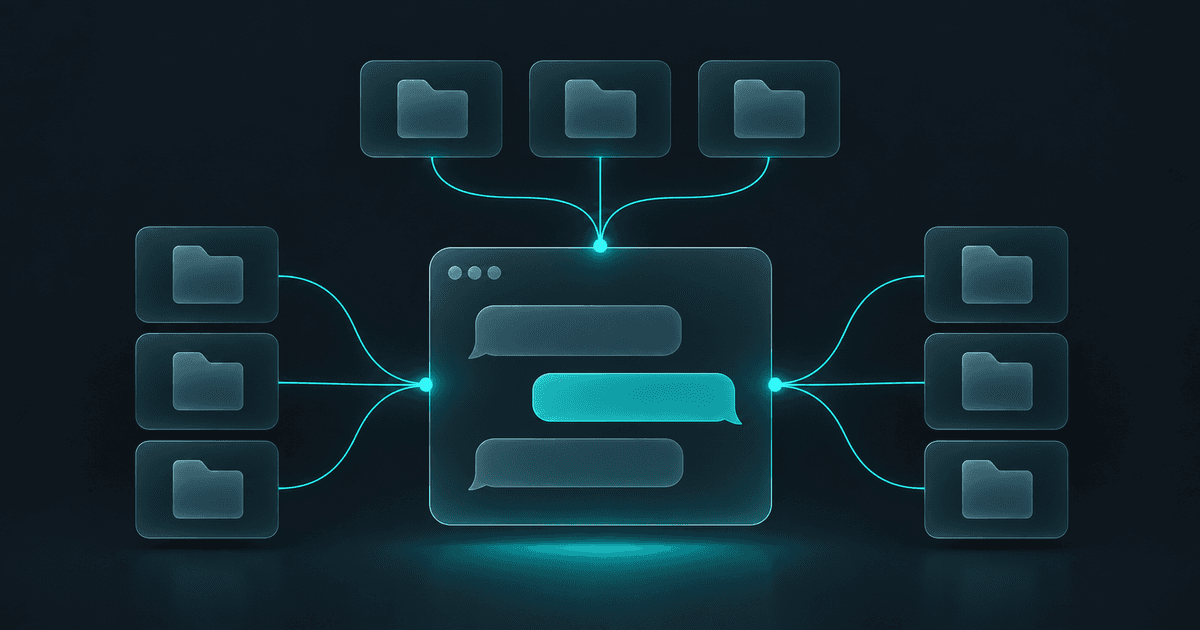
On November 24 I put 22 repos into three groups: nine personal tools, ten products, three sites. Each group got a headquarters. That sounds more impressive than what I built: a folder beside the repos, with its own private Git repository and no application code inside.
I open Claude Code there. One chat can see the whole group.
A repo for knowing about the other repos
When I went through about sixty repositories, part of the work was remembering what I had built. These hubs deal with a smaller question: what does an assistant need to know before touching several of them?
The files are mostly ordinary Markdown:
- AGENTS.md holds the shared rules for any agent, including Codex.
- CLAUDE.md imports it with a single
@AGENTS.mdline, then adds the Claude-specific details. - repos.md is the map: what each project is, its stack, deployment, status and latest commits.
- infra.md describes shared services and lists environment variable names. Names only.
- decisions.md keeps decisions. WORKLOG.md keeps the work history.
There are also four commands: /status, /refresh-map, /deps and /wrap. They give the chat a small vocabulary for checking the group, refreshing its map, looking at dependencies and wrapping up the work.
The code stays in its original repositories. So do their instructions. I haven't moved 22 projects into a giant new application. I've added three places from which I can ask about them.
I already have a dashboard where agents can write tasks. That gives the work somewhere to be recorded. The hubs give a coding chat the surrounding repository context. Knowing that a task exists doesn't tell it which project's rules apply once it starts editing.
Access comes with a few conditions
In .claude/settings.json, permissions.additionalDirectories points at the neighbouring repos. The same settings deny reads of .env files and keys, and require confirmation before git push, deployment, ssh or rm.
The working rules are deliberately dull. Before changing two or more repos, the assistant writes a plan and waits for my okay. Each repo gets its own commit. A project's own rules take priority over the hub's rules. Push happens only when I explicitly ask for it.
That last distinction matters to me. Approving a plan to clean something up doesn't also mean publishing everything the assistant happens to finish. I want to review the work at the point where it leaves my machine.
A group-wide chat makes it easier to reach more files. I don't want that convenience to quietly turn into permission to do more things.
Five things I got wrong or hadn't accounted for
The first surprise was what additionalDirectories actually gave me in this setup: file access. The neighbouring projects' CLAUDE.md files and commands didn't automatically appear in the hub's context.
I'd given the assistant the addresses. I hadn't introduced it to the neighbours.
The hub now reads their instructions explicitly. Otherwise, a map saying "this is a small app" could sit above a repo with quite specific rules that the chat had never read. The files being reachable doesn't mean the assistant knows what's in them.
The second problem was a .mcp.json file with ${ENV} variables. It broke the configuration with INVALID_CONFIG. Meanwhile, the MCP servers I needed were already arriving through the claude.ai connectors. We deleted the file. One less piece of configuration, one less way to fail before doing any work.
Third: the settings only worked after I trusted the hub folder. The rules and extra directories in settings.json didn't take effect before that. Writing down the intended permissions and actually activating them turned out to be separate steps.
Fourth: the assistant helping me assemble the hub couldn't write the Claude Code settings file itself. That was a protection boundary. I had to move the file by hand. Fine. An assistant being unable to quietly change the configuration that governs its own access seems like a reasonable inconvenience.
Fifth: one folder still returned Operation not permitted. That's a macOS permissions problem I haven't worked out. The project is paused. I don't have a clever fix to put in this paragraph.
All of this happened on the day I assembled the hubs. So did the first tests. This is a first-day report, with the usual first-day amount of evidence.
The first jobs were housekeeping
I started with /status in the personal-tools group. It matched the map for eight of the nine repos. The inaccessible folder kept the score from being more satisfying.
Then I asked the hub to deal with .DS_Store files in Git. A small enough job to see whether the rules survived contact with actual files.
The assistant that had assembled the hub had made a mistake: the relevant ignore rule existed only in a subfolder's .gitignore. The hub caught that while checking the task and corrected the plan.
This was a useful first result. The setup instructions themselves hadn't become unquestionable just because another assistant had written them. The chat looked at the repository and found a reason to change its approach before making the edits.
The second job involved old Expo files. One repo still tracked .env.production and .env.development from an earlier version.
The hub showed only the variable names. They were public EXPO_PUBLIC_* variables; it didn't open their values. It removed the files from Git's index. It also respected the project's own minimal-diff rule, which came from that repo rather than the hub.
Then it noticed another consequence: a line in the repo's CLAUDE.md would become untrue after the cleanup. The documentation needed to agree with the change.
That's the bit I liked. Removing a tracked file is easy to ask for. Remembering that a sentence elsewhere now describes a state that no longer exists is the sort of small follow-up I often end up doing myself.
Both jobs followed the same order: inspect, plan, wait for my approval, then make separate commits in the affected repos. Neither job ended with a push.
The push button had a quiet day.